
« Le passé composé » is the past you will use the most in french. It is used for general actions and events in the past.
It is made up of two things:
- An auxillary : In most cases to have : j’ai, tu as, il a …. , sometimes to be : Je suis, tu es, il est ……
- A verb in the past participle.
Here are a few examples, listen and read.
- J’ai perdu mes clefs.
- Tu as fini ton exercice.
- Il a vu sa mère.
- Nous avons mangé.
- Vous avez perdu.
- Elles ont bien chanté.
For the negative form simple add n’ and pas as follows
- Ils n’ont pas parlé.
- Le film n’a pas commencé.
- Je n’ai pas bien dormi.
In this lesson we focus on Passé Composé which uses « Avoir » (to have). You can revise it’s conjugation by clicking on the following link:
Participe Passé (past participle)
The past participle ending of er verbs is é
- manger –> mangé
- chanter –> chanté
- pleurer –> pleuré
The past participle ending of regular ir verbs is i
- choisir –> choisi
- finir –> fini
- investir –> investi
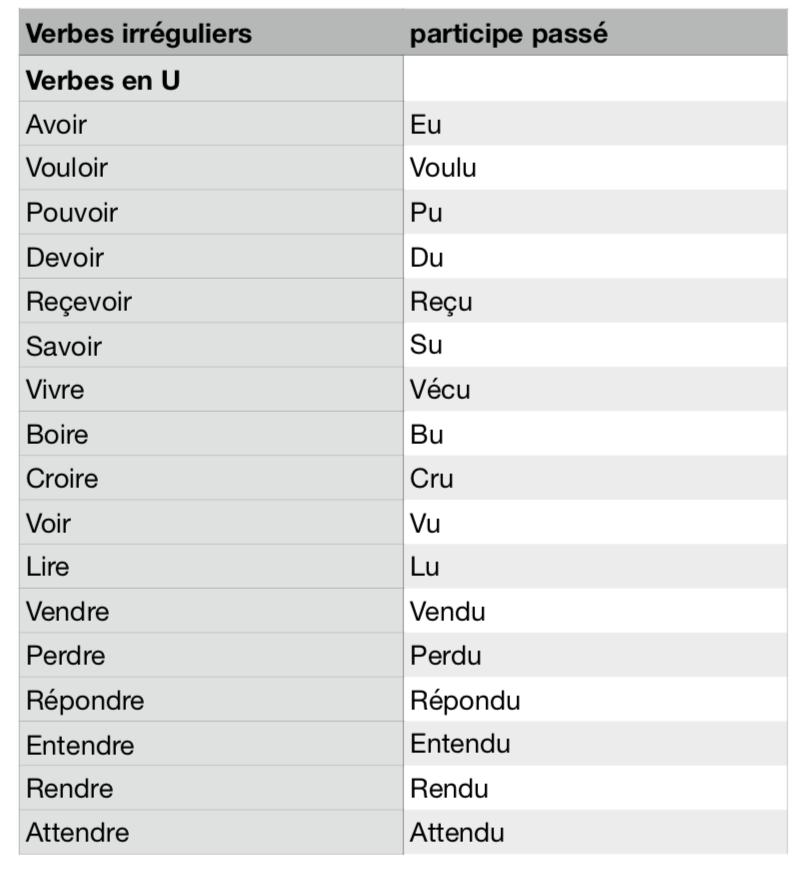
Irregular verbs past participle most often end with U
- Pouvoir –> Pu
- Vivre –> Vécu
- Vendre –> Vendu
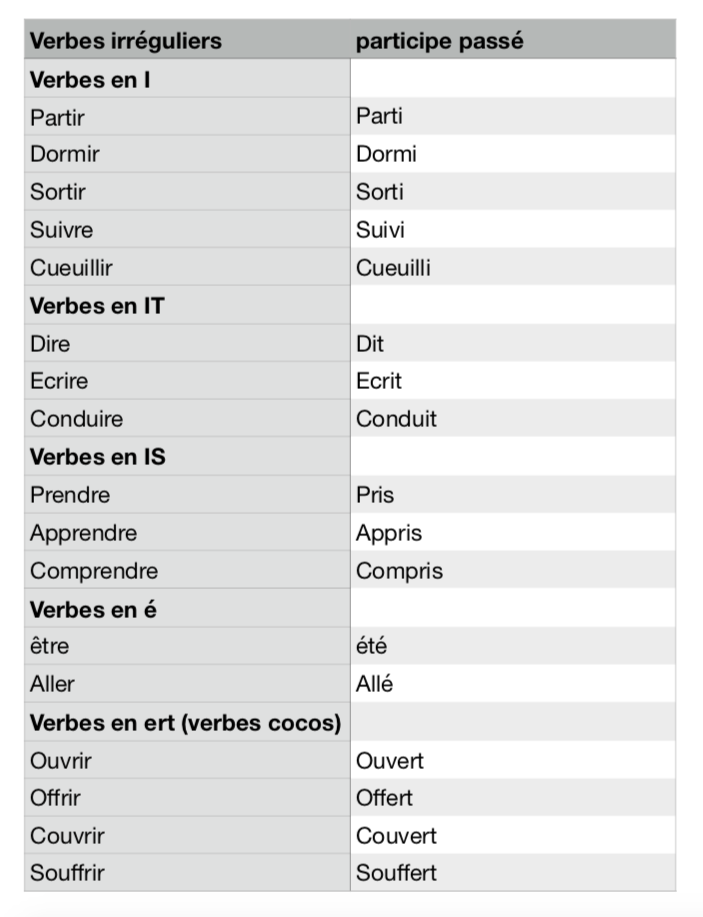
But they can also end with I, It, Is, É and Ert.
- Ouvrir –> ouvert
- Prendre –> pris
- Dire –> Dit
Here is a list of irregular past participles for you to learn 
verbes-irreguliers-francais-participe-passe-
Learning tip:
All ir verbs are pronounced « I » except ouvrir, offrir, couvrir and souffrir.
Verbs with « dre » normally end with « du » in past participle, except prendre, apprendre, comprendre.
Learning audio file
Listen to this audio to memorise. I say the infinitive of a verb, followed by « J’ai » + past participle. Some verbs have « Je suis » instead of « J’ai », don’t worry about that.
Example you will hear « avoir », and then you will hear « j’ai eu ». The verbs are in random order. You can use the pause button to have time to repeat the verbs.
Exercices
exercices-passe-compose-avec-avoir
exercices-passe-compose-avec-avoir-corrige